Define
Establish the entity schema, source contracts, ownership, access and the intended use of the master.
Domain contract
Governed master data
Golden brings records from different systems under an explicit entity model. It prepares and compares them, routes uncertain cases to the right people and keeps the governed result connected to its origins.
Master-data contract
A governed path
Golden separates the decisions that are often hidden inside a master-data process. Each domain defines what enters, how records become comparable, which candidates deserve attention, who resolves them and how the resulting master is operated.
Establish the entity schema, source contracts, ownership, access and the intended use of the master.
Domain contractTransform and validate each source against the shared model while retaining its system and record reference.
Quality & provenanceForm candidate groups and classify their similarity using the indexes, weights and thresholds chosen for the domain.
Candidate policyApply approved automatic rules or send the case to a steward, then use a separate survival policy for conflicting values.
Human authorityMaintain the master with quality findings, history and permissions, and publish it when a destination is configured.
Controlled useAurelia Utilities
This synthetic residential-customer domain focuses on the product moments that carry practical weight: finding a concrete quality problem, ordering duplicate work, protecting a near miss, previewing survival, measuring improvement and retaining the decisions behind it.
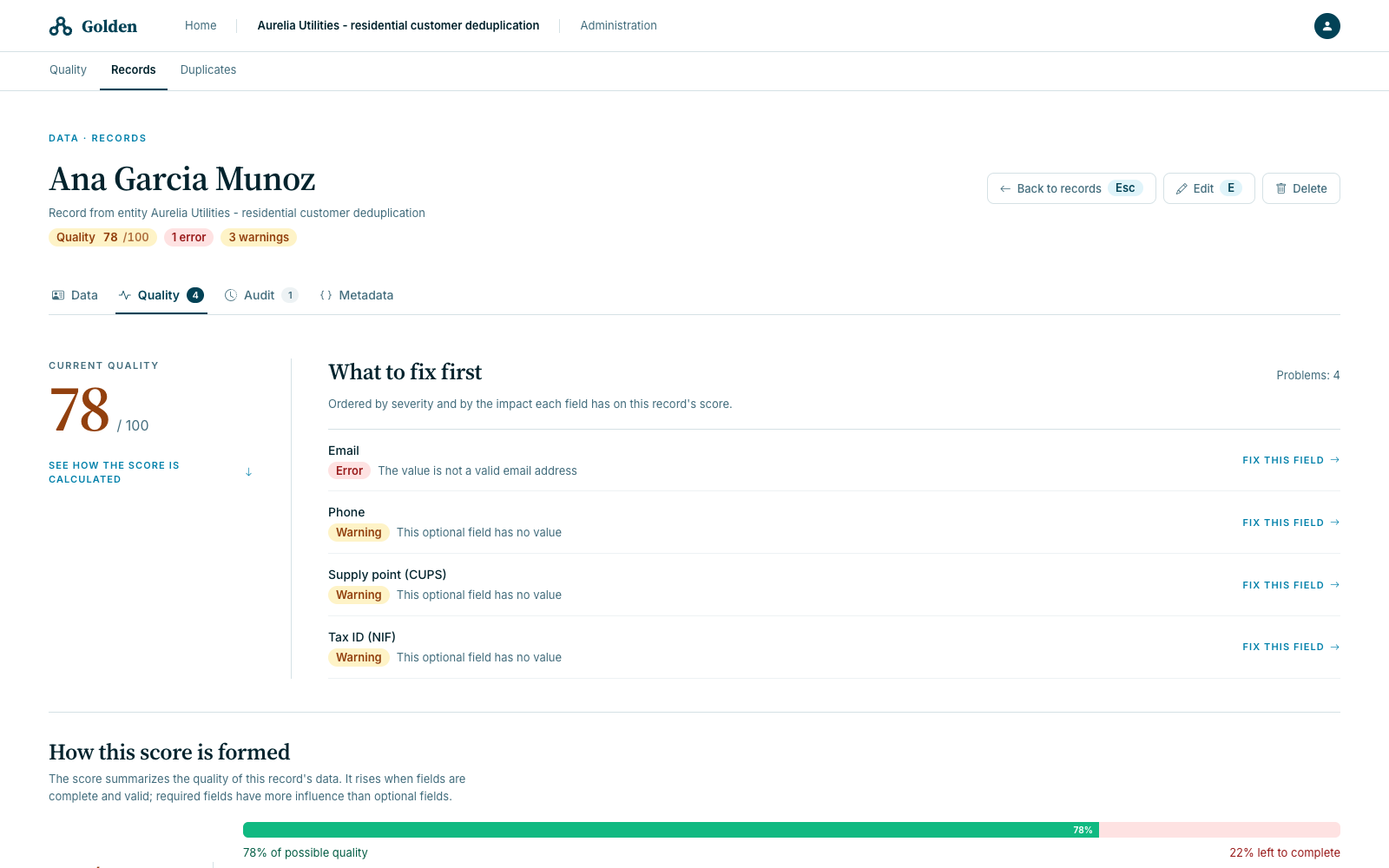
A concrete customer record scores 78/100 and explains exactly why: one invalid email and three missing values. Quality becomes an ordered repair list rather than an abstract grade.
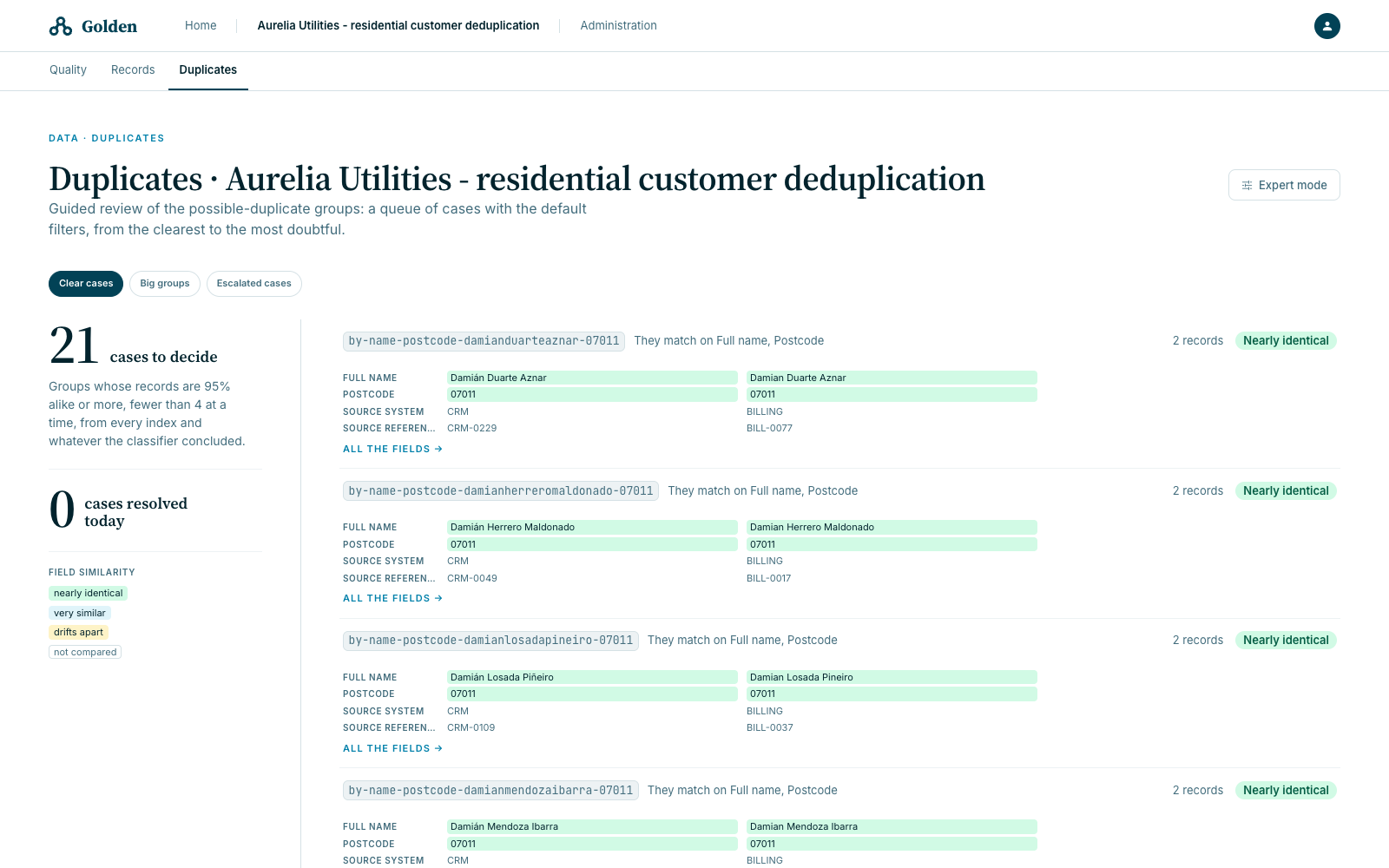
The queue communicates volume, confidence and source differences at once. Golden does more than detect duplicates: it gives people a practical way to resolve them.
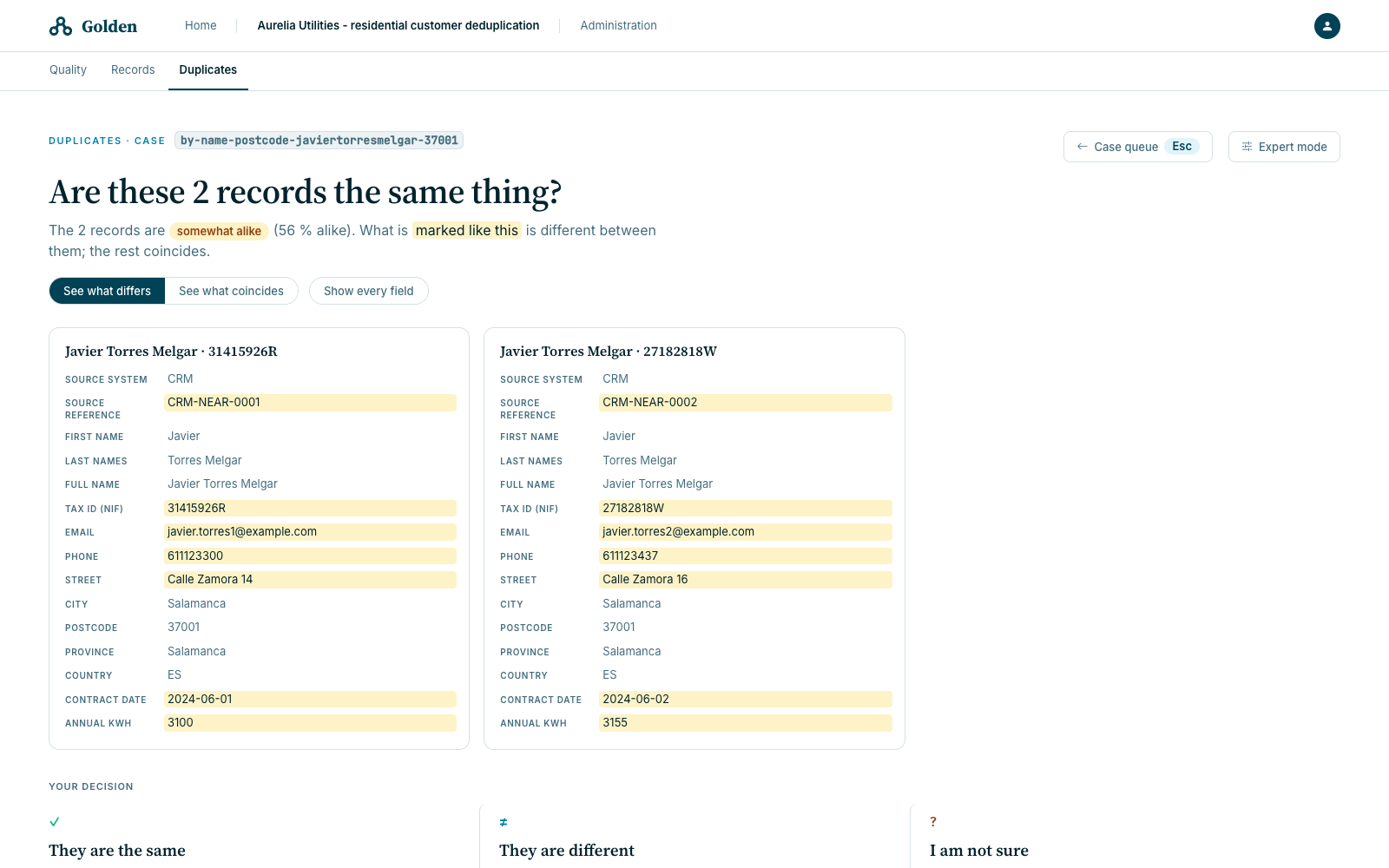
Two people share a name, postcode and city, yet tax identifiers, email, phone and address disagree. The 56% score and three explicit decisions show how Golden protects uncertain cases from automatic resolution.
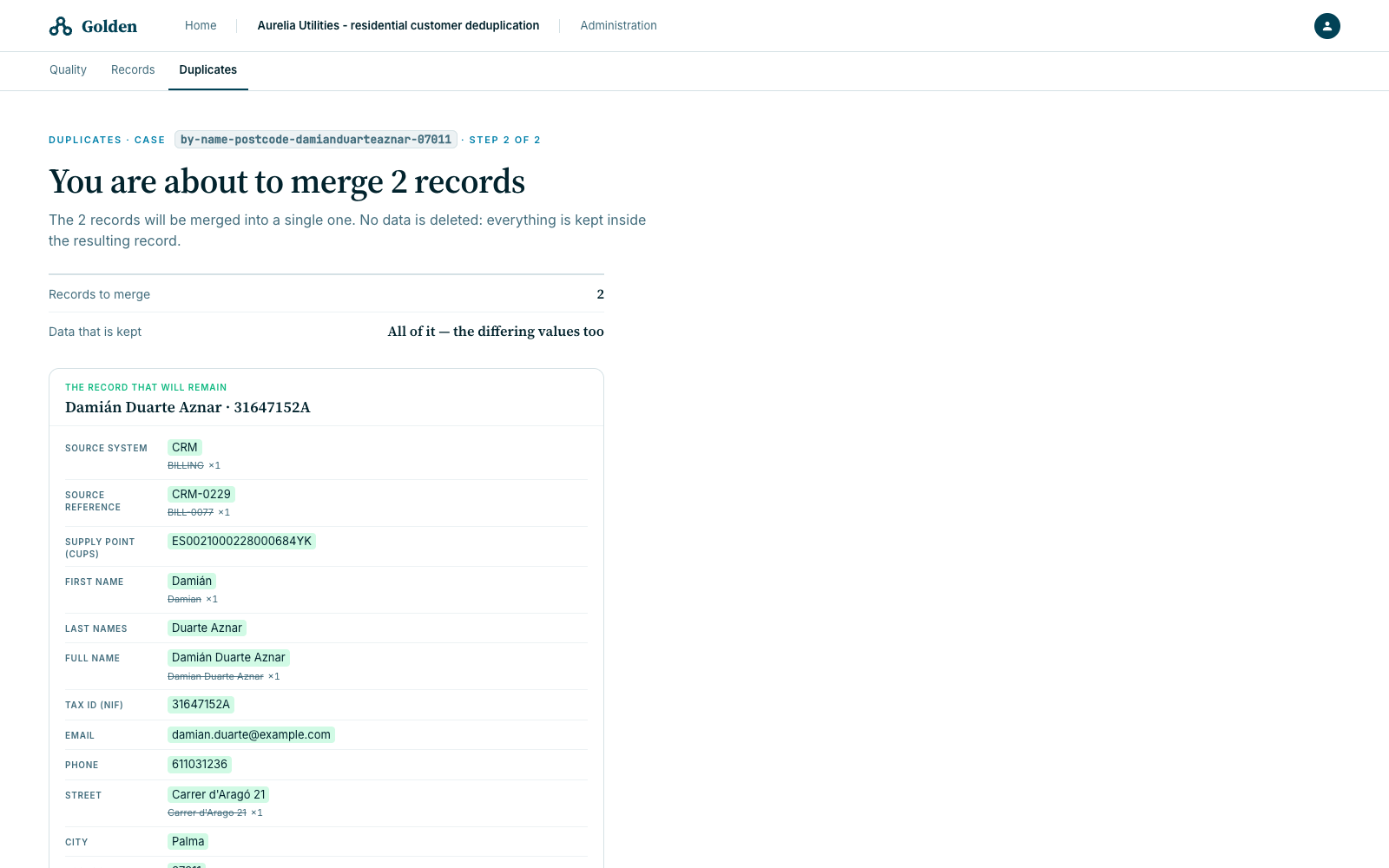
Before committing, Golden states which record remains, which values survive and which differing values are retained. The survival decision is explicit and reviewable.
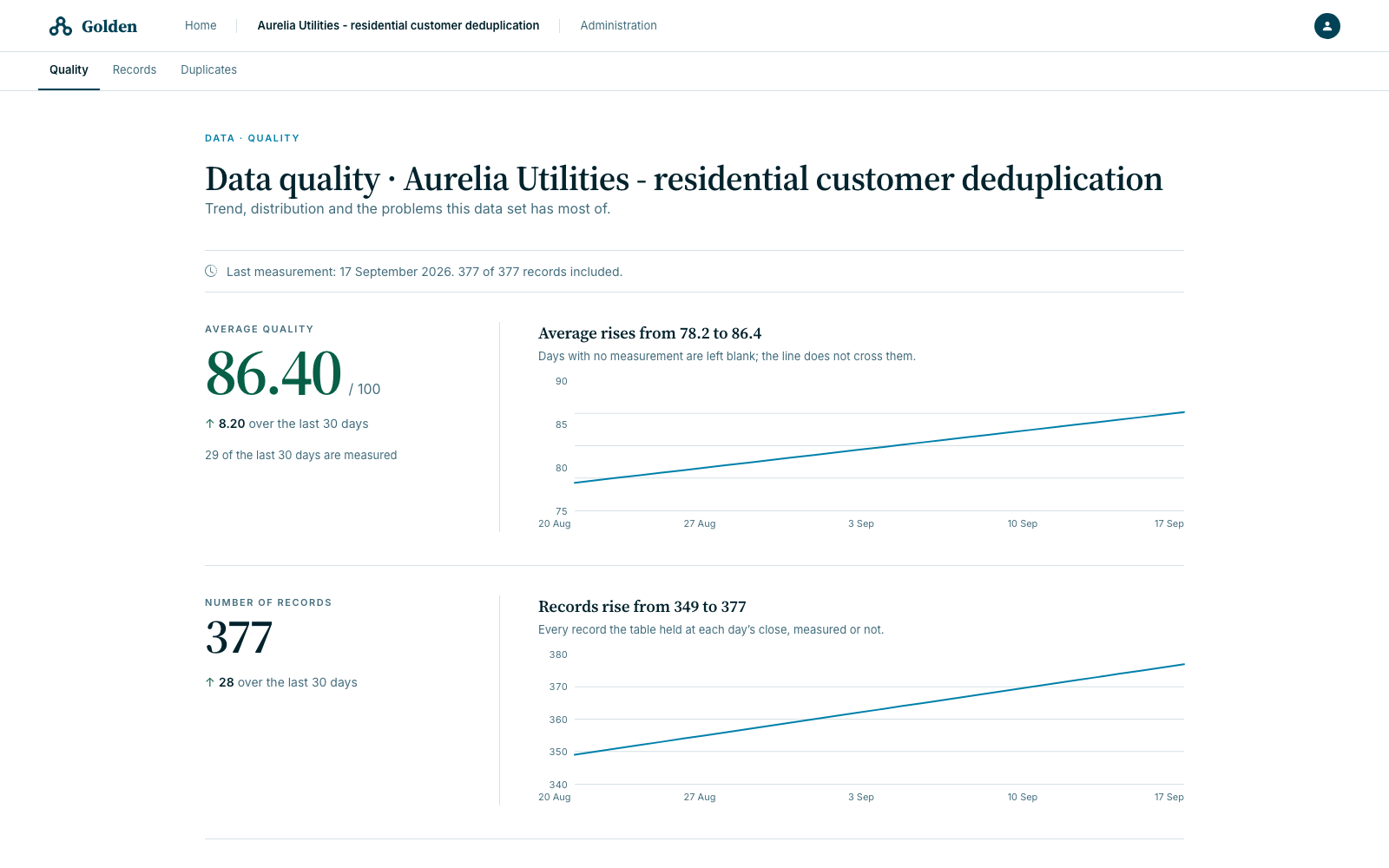
Average quality rises from 78.2 to 86.4 while the estate grows from 349 to 377 records. Improvement and scale remain visible together.
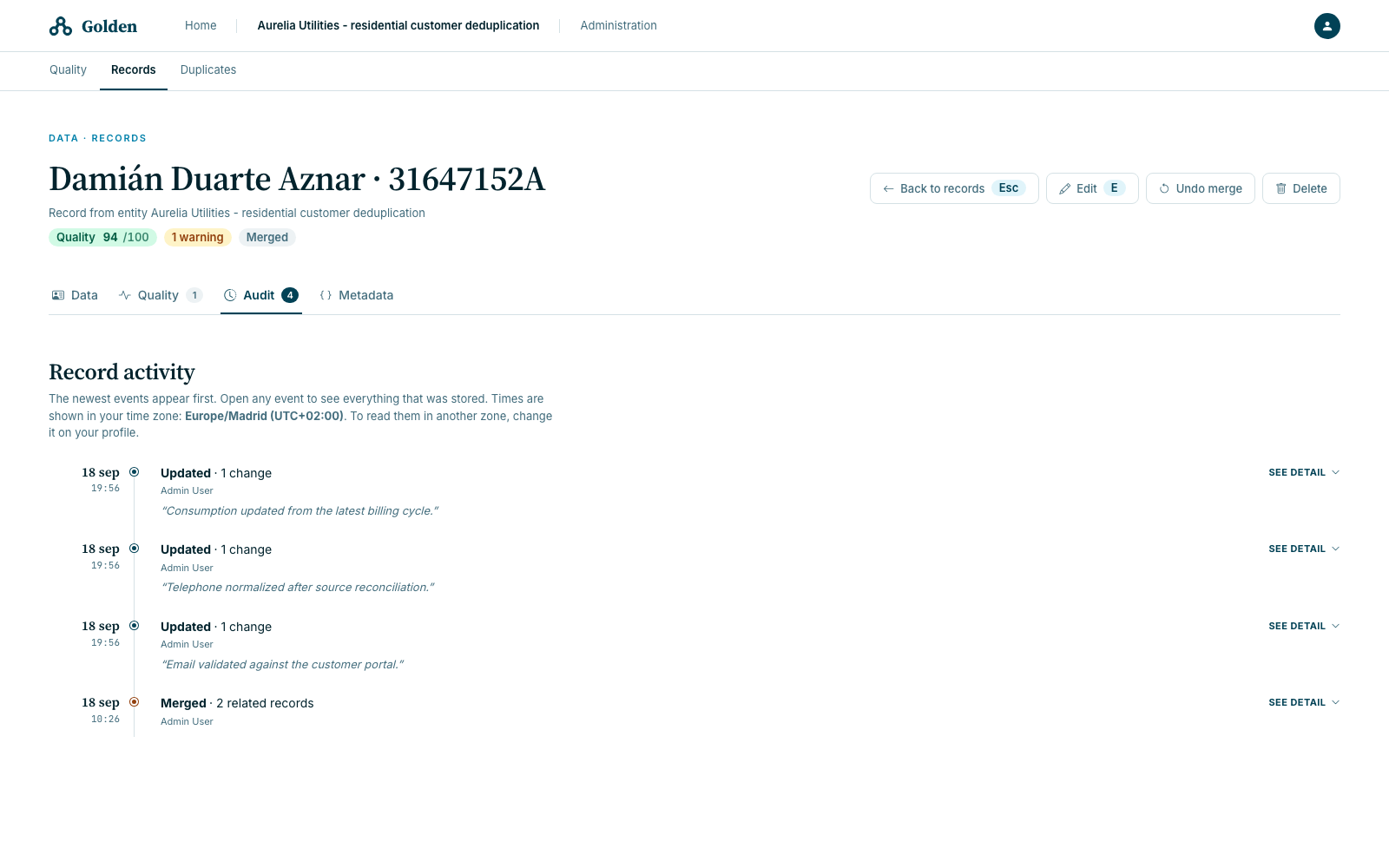
The timeline brings the merge and subsequent corrections into one place. Each update names its author, time, purpose and change count.
Technology
Golden is implemented as a Java 21 and Spring Boot system over PostgreSQL. Its engine composes typed resources, deterministic matching, explicit policy and transactional evidence rather than collapsing the work into one opaque score.
An entity binds datasets, sources, transformations, indexers, classifiers, mergers, stewards and sinks through typed resources.
Column types and nested datasets drive normalization, validation, comparison and the structure exposed through the API.
File, JDBC and table sources feed a domain; file, HTTP, JDBC, Kafka and table sinks serve configured destinations.
Field mappings and controlled Groovy transformations reshape source documents while preserving their declared context.
Exact, geographic and fuzzy indexes form buckets first. Weighted classification then decides how each group proceeds.
Rules consume eligible clusters in a defined order. Automatic resolution, review and value survival remain separate decisions.
A canonical SHA-256 definition identifies each measurement model; changes mark scores stale and preserve prior daily snapshots.
Record writes, history and immutable audit events share the same transaction, with partitioned storage and controlled access.
Practical scope
Golden is shaped around the entity the business needs to maintain, not a generic matching exercise. A first scope establishes the domain, its authority and a representative set of records before expanding sources or consumers.
Discuss your domainMaster domains
The schema, rules and authority are defined for each domain.
Implementation contract
Destinations and synchronization are included only when they are configured for the domain.
Customer results
The product is used for different master domains and source landscapes. These results describe the scale and boundary of two customer implementations.
Grupo Piñero · Customer master
Customer data reconciled under one governed model while retaining provenance, consent and language.
View customer resultIT Travel Services · Two domains
Traveller and destination masters replace repeated identity and location resolution in downstream analysis.
View customer resultStart with one domain
Bring the entity, its main sources and a representative set of records. We can begin by defining the operating boundary, the decisions that need policy and the cases that still need people.
Contact Trazadera